All products are independently selected by our editors. If you buy something via the links on our site, we may earn an affiliate commission at no extra cost to you. Learn More >
Have you ever wondered why your furry friend goes into pure bliss mode when you rub their belly?
It’s a common sight – a dog rolling onto their back, exposing their tummy, and kicking their legs in delight as you scratch that irresistible spot on your dog’s belly.
But what makes belly rubs so enjoyable for our canine companions?
In this blog post, we’ll uncover the fascinating reasons behind dogs’ love for belly rubs. From the deep-rooted psychological factors to the physical sensations, we’ll explore why this simple act brings such joy to our four-legged friends.
Get ready to understand your dog’s behavior better and learn how to give the ultimate belly rub experience!
The Belly Rub: A Sign of Submission and Trust
Have you ever noticed how your pup rolls onto their back, exposing their belly, and giving you those pleading eyes – almost asking for a belly rub?
It’s not just a ploy for attention – it’s a deep-rooted behavior that dates back to their wild ancestors.
1. Dogs Expose Their Bellies to Show Trust
When a dog rolls over and exposes their belly, they’re engaging in a submissive and appeasement gesture. It’s their way of saying, “I trust you, and I’m willing to be vulnerable around you.”
This behavior is ingrained in the canine pack mentality, where showing their belly to a higher-ranking pack member is a sign of respect and deference.
2. Belly Rubs and the Pack Mentality
In the pack, dogs would often groom and socialize with one another, strengthening their bonds and reaffirming their roles.
When you offer your furry friend a belly rub, you’re essentially mimicking this pack behavior.
By allowing you to rub their belly, your dog is showing submission and trust, just as they would with a higher-ranking pack member.
3. Building a Bond Through Belly Rubs
Belly rubs aren’t just a one-way street of submission; they’re also a powerful way to deepen the connection between you and your canine companion.
When you take the time to gently rub your pup’s belly, you’re fostering a sense of trust and affection.
It’s a special moment where your dog can let their guard down and truly enjoy your company, knowing that they’re safe and loved.
After all, what better way to show your love than by indulging in their favorite activity?
Dog love: Think of it this way, if a dog could give hugs, a belly rub would be their way of wrapping their paws around you and saying, “You’re part of my pack, and I adore you.”
So, the next time your furry friend rolls over and offers their belly, don’t hesitate to give them the ultimate sign of trust and affection – a good old-fashioned belly rub.
The Physical Pleasure of Belly Rubs
Have you ever wondered what’s really going on behind those furry wiggles and kicks when your dog enjoys belly rubs?

The Scratch Reflex: Why Dogs Kick During Belly Rubs
You know that adorable kicking motion your dog does when you rub your dog’s belly? That’s not just a random spasm of joy (although it’s certainly a sign of enjoyment!).
It’s actually called the scratch reflex, and it’s an involuntary reaction triggered by the stimulation of certain nerve endings in your pup’s skin and hair follicles.
Think of it like a full-body tickle – when you hit those sensitive spots, it sends a pleasurable sensation shooting through your dog’s somatosensory system (the part of the nervous system responsible for processing touch, temperature, and pain).
That’s why their legs start going a million miles a minute – it’s their body’s way of saying I want belly rubs, “Yes, please, more of that!”
Targeting the Best Belly Rub Spots
Of course, not all belly rubs are created equal.
Experts recommend focusing your attention on the lower belly and sides, as these areas tend to be more sensitive and enjoyable for our furry friends.
Avoid rubbing too vigorously on the upper abdomen or chest, as these spots can be a bit too intense or uncomfortable.
The Calming Effects of Belly Rubs
But belly rubs aren’t just about physical pleasure – they can also have a profound effect on your pup’s emotional well-being.
Research suggests that the gentle touch and bonding experience of a belly rub can actually promote relaxation and happiness in dogs by increasing their levels of oxytocin (the “cuddle hormone”) and stimulating the release of endorphins (the body’s natural “feel-good” chemicals).
So, the next time you’re feeling stressed or anxious, why not give your furry pal a belly rub?
Not only will it put a smile on their face, but it might just calm your own nerves, too.
After all, there’s nothing quite like the soothing power of a good tummy rub to remind you of the simple joys in life.
Dogs Asking for Belly Rubs: Recognizing the Signs
If you’re a dog owner, you know that our furry companions have their own unique ways of communicating with us. And when it comes to belly rubs, they’re not exactly subtle about their desires.
In fact, they might as well be holding up a neon sign that says, “Rub me here, please!”
Rolling Over and Exposing the Belly
Let’s start with the most obvious sign: the belly flop. You know the move – your pup will flop onto their back, legs sprawled out, and belly exposed in all its furry glory.
It’s the doggy equivalent of a big, flashing neon sign that reads, “Free belly rubs here!”
How can you resist that adorable invitation?
Pawing and Nudging for Belly Rubs
But what if your pup is feeling a little more assertive? That’s when the pawing and nudging comes into play.
You might be sitting on the couch, minding your own business, when suddenly you feel a gentle (or not-so-gentle) paw tapping your arm or leg.
And when you look down, there’s your furry friend, staring up at you with those big, pleading eyes, as if to say, “Hey, remember me? The one with the belly that needs rubbing?”
Vocalizations: Whines and Grunts
If pawing and nudging doesn’t get your attention, some dogs will resort to more vocal tactics. You might hear a soft whine or a gentle grunt, almost like a polite throat-clearing to remind you of their belly rub needs.
And if that doesn’t work?
Well, let’s just say you might be treated to a full-on concert of whines, grunts, and maybe even a few strategic barks, just to really drive the point home.
Of course, every dog is different, and some might prefer a more subtle approach (or perhaps they’re just too polite to beg). But one thing’s for sure – when a dog wants a belly rub, they’ll find a way to let you know.
So, keep an eye out for those telltale signs, and be prepared to indulge in a little belly-scratching session whenever your pup requests it, but be mindful if your dog doesn’t like it.
After all, a happy dog is a happy life, right?
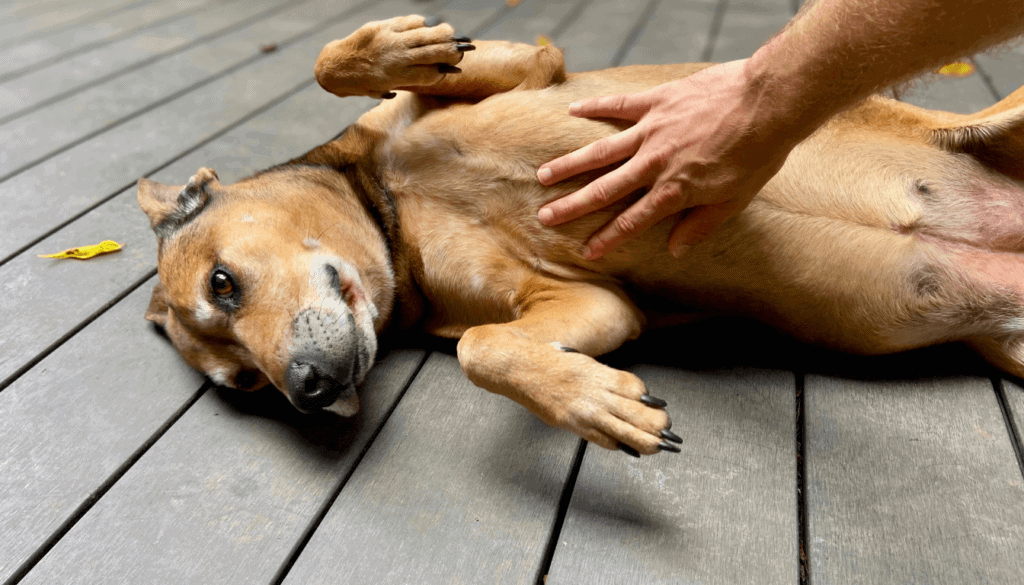
How to Give a Great Belly Rub
Ah, the art of the belly rub – it may seem simple, but trust me, there’s a technique to it.
Giving a great belly rub is a delicate dance and one that requires a little finesse.
Finding the Sweet Spots
First things first, you’ve got to locate the sweet spots. Just like us humans, every dog has their own particular areas that just hit differently when it comes to belly rubs.
Maybe it’s that little spot right above their hind leg, or perhaps it’s the fluffier tufts of fur along their sides.
The key is to pay attention to their body language and reactions – when you hit that sweet spot, you’ll know it by the way their leg starts thumping or their eyes roll back in pure bliss.
The Right Technique: Gentle Scratches and Rubs
Once you’ve found the prime real estate, it’s all about the technique. Forget about those heavy-handed, knuckle-digging rubs – we’re going for gentle scratches and soft, circular motions here.
Think of it like a massage but for your furry best friend.
Use the tips of your fingers to lightly scratch and rub, adjusting the pressure based on their reactions. Too firm, and you risk overstimulating them (and trust me, an overstimulated dog is not a happy dog).
Belly Rub Duration: How Long is Too Long?
Now, here’s the real tricky part: knowing when to call it quits.
Some dogs could happily bask in the glory of belly rubs for hours on end, but others might start to feel a little overwhelmed after just a few minutes, and a dog may move away when they’ve had enough.
Again, it all comes down to reading their body language – if they start to squirm, pant excessively, or try to roll away, it’s probably time to wrap things up.
Remember, a good belly rub session should leave both of you feeling relaxed and content, not frazzled and overstimulated.
So, there you have it – the secret sauce to mastering the art of the belly rub. It’s all about finding those sweet spots, using the right technique, and knowing when to call it a day.
Trust me, get it right, and you’ll have a loyal, blissed-out companion for life.
After all, the way to a dog’s heart is through their belly – or at least, that’s what I’ve always been told.
Wrapping Up
We’ve covered a lot of ground when it comes to the art of the belly rub. From finding those sweet spots to mastering the perfect technique, we’ve explored the ins and outs of this beloved canine indulgence.
But at the end of the day, what it really boils down to is one simple truth: belly rubs are a love language that transcends species.
They’re a way for you to show your furry pal just how much you care, and for them to reciprocate that affection in the most delightfully goofy way possible.
So, the next time your pup rolls over and gives you those irresistible puppy dog eyes, don’t hesitate – dive right in and give them the belly rub of a lifetime.